Category Archives: Full reviews

On April 4, 1748, the French were embarking in the last major offensive in the War of the Austrian Succession, and someone wanted to run a human through the then-new field of taxidermy.

(From mezzacotta. Click for full-sized complex games. IE users will need to get something to allow them to see SVG files.)

On October 10, 2008, the long-running, once-delayed-but-twice-changed, countdown running at mezzacotta.net finally reached its conclusion, unveiling the latest project from the circle of friends known as the Comic Irregulars (named for Irregular Webcomic! and best known for Darths and Droids).

The centerpiece of the site was a webcomic. One requiring SVG support in order to be able to see it. One with archives going back before the site’s launch… indeed before the advent of the Internet… indeed extending into the BC era… indeed before the estimated age of the entire universe. Obviously such a comic would need to be automatically generated in order to have archives dating back that far, and indeed most of the characters and lines seem to fit a cookie-cutter pattern, from identified sources ranging from the Dungeons and Dragons manual to Irregular Webcomic! In fact, there are certain patterns with certain “characters” that has led to the creation of a cast page.

(The only thing missing? Lines from other webcomics not affiliated with David Morgan-Mar. I know he’s done at least three xkcd pseudo-parody strips, I’d like to see the characters spout some lines from that – that’d be really surreal. Dinosaur Comics would add an… interesting vibe to say the least, and might fit best of any other webcomic. Order of the Stick would make the whole thing even more surreal yet paradoxically give the D&D manual quoter someone to talk to. Really crappy idea, but it kinda fits, for reasons I get into below.)

But how? The strip “for” the most famous date of this millenium (and a few others) call it a “randomly generated comic“, which would seem to suggest each strip in the “archive” is only generated when someone visits that date. Since each date generates the same strip each time, that would in turn seem to suggest the mechanism in place then saves that comic to that date for any future visitors. 24 hours after the site’s launch, David Morgan-Mar (the group’s apparent leader and proprietor of IWC) seemed to back up that theory by proclaiming mezzacotta the new comic with the most strips (supplanting Sluggy Freelance) on the basis of how many strips had been viewed in the archive, a statistic that would be most relevant under such a model.

But why use a two-part mechanism for that purpose? Why set yourself up for future potential space strain down the road by even having the endless archive in the first place? How do we know this “evidence” isn’t a misdirection, and the comics are actually generated based on some formula from the date, one complex enough it might seem random? With the evidence seemingly this obvious, why are Morgan-Mar and the other Comic Irregulars still putting on a show about being tight-lipped about all the workings?

With the method of comic generation, the vast majority of the comics are bound to be incomprehensible crap, but that comes with the territory; a comic rating system allows more comprehensible and even funny comics to rise to the top and get viewed more. But mezzacotta the webcomic – which derives its name from some form of the Italian for “half-baked” (good luck reverse-engineering that result from an automatic translator though) – is just one example of a, well, half-baked idea to come out of mezzacotta the site. As Morgan-Mar described it on the first day:

I lamented that the problem with our furious generation of ideas and our attempts to implement them was that we kept needing to register new domains for sites that might turn out good, but are in fact more likely to turn out truly half-baked and never do much. What we needed was a single site which could be a central repository of half-baked ideas that we sort of half-implement, to see if they’re any good.

mezzacotta is that site. [...]

So, the initial idea was half-baked. The countdown timer was half-baked. … The webcomic is half-baked. Everything about this site is half-baked. That’s what mezzacotta is.

Welcome to our central repository for half-baked web implementations of half-baked ideas. Most of the stuff on this site won’t be great. But by just throwing it all out there and daring to be stupid, you’ll get to discover the rare gems that we might generate and not immediately recognise ourselves.

Coming up with ideas is easy – anyone can do that. Actually doing something about them is the hard part. Anyone who’s done it knows how much sweat you have to put in to get an idea beyond the “hey, wouldn’t it be cool if…?” stage. This is our place for doing the hard work. It’s a spur to drive us to do something with some of those crazy half-baked ideas we get. And hopefully we’ll entertain a few of you, rather than just ourselves.

It’s impossible to say anything about the above without in some way rephrasing it. Beyond being a single… experiment, for lack of a better word, mezzacotta is a place for throwing ideas on the wall and seeing what sticks, some of which amounts to little more than that, some of which results in some actual implementations. That includes even a couple other webcomics.

Lightning Made of Owls, inspired by a completely random phrase posted on the mezzacotta blog, is essentially a redo of a pre-mezzacotta concept, Infinity on 30 Credits a Day, both of which are attempts at collaboratively-written-and-drawn comics. Because ∞ on 30Cr a Day has an ongoing story, it’s gotten bogged down in administrative tasks and competition for the “best” strips. LMoO was conceived from the start as a gag-a-day comic with six characters that are very rough sketches, with comics to be sent in completed, not as scripts for artists to work on. Needless to say, the result is somewhat… disjointed, and there’s very little to unite the various appearances of the characters into coherent, well, characters.

More interesting – and potentially making its way into my RSS reader – is Square Root of Minus Garfield, inspired by Garfield Minus Garfield and other mashups of the Garfield comics. Let me say upfront that I don’t really get the hatred many have for Garfield. I find it entertaining enough, and in fact it’s one of only four newspaper comics I have really taken an interest in getting the book collections for and following in any way. In recent years (by which I mean the most recent years to be released in the book collections) it’s felt like it’s been running out of ideas, and the seeming disappearance of such characters as Arlene, Pooky, and to a lesser extent Nermal seems ill-timed and exascerbating to the ongoing decline, but the early years, through the mid-to-late 90s at least, were funny enough comics to hold me captivated. (But then, I read Ctrl+Alt+Del.) I hear (again, I only keep up with the book collections) that in recent years Jim Davis has resorted to advancing the Jon-Liz relationship beyond the unrequited and hopeless puppy love it had been for, what, two decades? That just smacks of desperation to me.

Secondly, as popular as G-G has become (to the extent of actually inspiring an officially sanctioned book), I actually find the mashups that remove Garfield’s dialogue, not Garfield himself, to be more appealing. G-G essentially says, “Wouldn’t it be cool if we took these Garfield strips and get rid of the title character? See how crazy Jon looks!” Only stripping the dialogue, on the other hand, has a more appealing hook as – assuming Garfield isn’t actually speaking despite the thought balloon and isn’t communicating through telepathy – it depicts how things actually happen from the perspective of the human characters. It really drives home the idea that Jon is crazy when it actually reflects something actually happening in-universe.

(Incidentially, take a look at the strip to the right, from page 3 of the original T&BB thread. It attracted such comments as “I can’t even imagine it with Garfield saying something” and even “This is one of those weird ones, where you know Jon isn’t actually supposed to hear Garfield, but clearly this is in response to something Garfield said. Huh.” Certainly that’s a common enough feature that it’s sometimes confusing whether or not Jon is or isn’t supposed to “hear” Garfield’s thoughts. Replying to the latter comment, one poster psychoanalyzed the resulting mashup:

I like it because it’s as though Jon takes a moment to consider what he said, mentally kick himself and then project that hatred onto his cat. It’s a neat little psychological study that I quite like. I’m not entirely sure that Jim Davis didn’t plan this all along and that we’re merely forging the next step of his global empire.

The kicker? The original comic – posted at left because the Garfield web site doesn’t seem to have a way to permalink to old comics, which is kind of ironic and stupid when you think about it because it forces people like me to “pirate” the strip, and forces √-G to link to the individual comic images, neither of which allows Garfield to benefit from its web advertising – doesn’t actually have Garfield saying anything in the second panel. In fact, all he says in the strip is “I didn’t say anything”. Jon’s remark actually was in response to nothing in particular, and much of his neuroses in the “modified” strip actually were intended, rather obviously, by Davis all along – or don’t exist even in the “modified” strip. Does this say more about Garfield (and if so, is it positive or negative), or about the people who like to bash it?)

Anyway, √-G is essentially a different mashup of a different comic each time it comes out. Some of them so far are really little more than changing the dialogue or the pictures in a slightly surreal way, and one really only shines a light on an old series of strips with two identical panels. But it’s somewhat fascinating nonetheless for anyone who’s been interested in Garfield mashups. And… I don’t know why I wasted time with other Garfield related stuff.

But I do have to sympathize with the Comic Irregulars’ plight. I too have way too many ideas than I would ever be able to work on. The web site is, in many ways, my own version of mezzacotta, a repository for all my many and varied ideas, be they the 100 Greatest Movies Project (still on indefinite hold), my street sign gallery, Sandsday, the football lineal titles, or my college football rankings. And then there are the projects I host right here on Da Blog. There are some ideas that, for some reason or another, I just can’t implement, at least alone. Here’s a brief start on getting started on a list of ideas I may not be able to implement myself, but that I’d like to see fruition in some way, shape, or form:

  • Election results based on my projection formulae. Would require a source of results and a group of people willing and able to call races based not on their own biases, not on unreliable exit polls, not on past performance, but on nothing but the results themselves.
  • Truth Court: Sorting out fact from fiction in politics based on hard evidence, and always open to new evidence or a new interpretation of old evidence. Like Mythbusters or Snopes, but more focused on questions like “Do people cause global warming?” and “Was the 2000/2004 election stolen?” and “Do gun control laws help or hurt violent crime?” and “Was 9/11 an inside job?” and “Does supply-side economics really work?” and “Who’s really to blame for economic and/or foreign turmoil, the current president or the preceding one?” and…
  • Similarly, a (bi/nonpartisan) web site dedicated to “keeping the media in check – and the blogs that watch them”.
  • The 100 Greatest Movies Project, currently on hold indefinitely on my end unless and until my old USB drive’s stuff comes back. Even if I have to shut it down, I’d like to see someone else take it over and do it justice; even if it does come back, I know for a fact I need a third person to do write-ups (I have two at the moment, including me). More here.

That’s just the ones for which I’ve solicited comment at mwmailsea at yahoo dot com (except the third). I have a bunch more ideas bouncing around in my head, some of which I just haven’t mentioned, some of which I’d still like to try to do myself, some of which I don’t feel I can reveal yet. I’m a veritable font of ideas in a wide variety of topics. I can only hope that I can bring as many as I can out into the open for you to peruse… and that they don’t turn out half baked.

If this post is full of the HTML code for an ampersand in hyperlinks that get broken as a result, blame Blogger’s “draft” post editor.

(From The Order of the Stick. Click for full-sized lingering resentment.)

I’m here to talk about a serious malady sweeping the nation. It’s called OOTS Gamer Theory Syndrome, or OGTS.

The malady is restricted to readers and fans of the popular webcomic Order of the Stick, and is caused by falling under the perception that the strip is actually a chronicle of a D&D campaign, rather than merely being set in a universe that runs on D&D rules. Symptoms are generally only manifest on the OOTS forums, and include referring to “_____’s player” and “the DM” (which may or may not actually be a representation of Rich Burlew), and interpreting characters’ actions through the lens of the “player” supposedly carrying those actions out.

It’s reasonable to fall under this perception anytime (I myself once proposed that the strip would end with just such a revelation), as the distinction can be hard to grasp for new readers (especially those already immersed in D&D), and to some extent Rich has played with the notion of a GM being present from time to time, but for whatever reason it has become particularly common recently, with virtually every strip’s thread (and a few others as well) eventually including some post that looks at what’s happening from a “game” point of view, despite Rich being on record in stating that there are no “players” at all, and despite evidence ranging from NPCs as fleshed out as any PCs (especially the main villains) to the very existence of the prequel books. Rich even made reference to the phenomenon in a recent strip.

One result has been a mere shift in terminology: “_____’s hypothetical player, if there was a player…”

It’s hard to figure out what’s causing this sudden move to proclaim it merely a game. Perhaps it’s a result of a few people happening upon and reading too much Darths and Droids for whatever reason. Perhaps it’s a result of impatience with the seeming abandonment of the megaplot.

Or perhaps it has something to do with the specific content. At least one forum member recently complained that the strip had traded in being “consistently funny” for “player motivated drama”. More than a few people, including one thread I linked to above, have compared the current state of the OOTS to a gaming party in disarray, with everyone upset at the DM and the DM himself slowly losing control of everything. (Oddly, although the interpretation of OOTS-as-campaign has become popular, the exact nature varies: some see the split as partly player-driven – possibly as a means of filibustering a main plot they didn’t sign up for – some see it as the DM railroading the players and wasting everyone’s time, and some even see it as being the victim of circumstances.)

That may at first be just a variant of the megaplot being abandoned, but consider:

  • Celia has effectively slid into Roy’s role in the Order, if only in filling out the Order’s nominal six members.
  • Within the current book, we have seen what has been happening with Team Evil for exactly one stint. We haven’t seen the Linear Guild at all. Not since the first book has any book been so Order-centric.
  • Similarly, Vaarsuvius appears to be the only member of the Order that cares that much about the gates anymore. (Well, and Roy.) Durkon and Elan don’t even seem concerned about reuniting the Order, and Haley, Celia, and Belkar (and for that matter, V) are powerless to do anything about it, and are a bit distracted at the moment.
  • The whole sequence with Roy’s pseudo-ghost seems more pointless than the sidequest itself. Roy can’t affect the material plane, the use of his looking down on the mortal world as a framing device has mostly been abandoned, etc. This strip may be the most pivotal strip of his time as a ghost.
  • Vaarsuvius’ behavior has been seen as out-of-character by many fans. Either V’s player is sending a not-so-subtle message to the DM to get the plot moving, or he’s been taken over by someone else. (This is undermined both by V’s decision to splinter the group further, and by considerable evidence in earlier strips that, if not un-Good, V’s certainly not Lawful.)
  • Previously, there was a fairly straight line, with only a slight diversion for the climactic confrontation with the Linear Guild, from the revelation of the nature of the gates to the Battle of Azure City. (As I may have mentioned in the past, the end of the Azure City arc could well, had it ended slightly differently, been a potential stopping point for the whole strip.) The tone of the strip now is actually quite similar to what it was prior to that revelation, and could be seen as a reaction to the considerable darkening of the strip/campaign that didn’t come that long before.
  • The OOTS has been split for nearly a quarter of the strip’s entire existence, and Roy has been dead for more than a quarter. As I’ve mentioned in the past, Rich has never been shy about shaking up the status quo, but this shake-up is literally blocking the plot from moving. If you don’t have faith in the relevancy of all this to the main plot – and that faith has been waning with every strip, especially those focusing on the Therkla and Thieves’ Guild subplots – you might think Rich had written himself into a corner, intending a fairly brief diversion to cool down from the ramped-into-gear main plot and going out of control. Forget a breather episode, this is an entire breather book and most of the forum-bound fandom thinks it’s overstayed its welcome.

Last time I wrote about OOTS, I said that “this section of the OOTS’ story is going to have far-ranging consequences that could prevent some of those goals from ever being completely fulfilled.” I was referring to V’s decision to leave the Durkon/Elan branch of the OOTS in #599, which I suspected could result in the de facto permanent removal of Durkon and Elan from the OOTS. That’s one far-ranging consequence that may be being set up, but what about everything else? What was the point of introducing Kubota and fleshing him out just to abruptly kill him? What was the point of the whole Therkla thing? What’s the point of what’s happening now with the Thieves’ Guild? What’s the point of stretching out the split itself this long?

Not only is the fandom starting to get restless about their ability to believe that this will all matter in the end, it’s starting to take several leaps of faith to link this to the main plot. Kubota was just a feint to introduce Qarr; Elan and Haley’s relationship is going to be strained; the Thieves’ Guild is going to become a recurring villain group; by the time the OOTS get back together Team Evil is already at Girard’s Gate. The mere fact I’m making these leaps of faith rather than treating it as a diversion is a sign of how it’s gone longer than most people would probably have expected or liked.

The OOTS has drifted off the beaten path before, of course. Their lengthy encounter with the bandits has had zero impact on anything that’s happened since then, but it came before the Order met Miko, let alone learned about the Snarl, and can be excused by the strip still being at least partially a gag strip then. All their encounters with the Linear Guild have of course had next to nothing to do with the gates (so far, but that will almost certainly end the next time they show up, given evidence here and here), but the encounter in War and XPs, besides tying up a loose end from the pre-Snarl era, leads to Haley getting her voice back and keeps the OOTS distracted enough not to run off to the wrong gate – which in fact, given some of what we know about Girard’s Gate and the potential of the Oracle’s prophecy to be twisted, could well be what’s happening here. (More on how the Linear Guild’s encounters with the OOTS has really affected them in a later post.) So far, it’s far from clear even if this will have any long-term impact.

It’s possible that Rich had over-emphasized the plot from about #275 (or even #200) onward, and that the plot has only ever been incidential to the humor. In this theory, people who are complaining about the pace at which the plot is moving are misinterpreting the nature of the entire strip. But if so, it’s a widespread enough misconception that at least some of the blame has to be heaped at the feet of Rich Burlew, because he created the circumstances that are now ruining people’s enjoyment of what might be, beyond the surface, actually a fairly entertaining part of the strip’s history. And if it’s not a misconception, and Rich really is taking a long time on what might be a comparatively small plot point, it may well be the most major blemish on the Giant’s record. (The first snag in a new fabric of reality, perhaps?)

None of the people complaining, to my knowledge, have ditched the strip. And I’m not among those who isn’t appreciating the strip for what it is at the moment. I’m not one of the players complaining to the GM. But it’s clear that the player mutiny is growing to disturbing levels, and it’s something the GM may have to address with more than a wink and a nod soon. Ultimately, the spread of OGTS may be most directly attributable to Rich Burlew himself.

I would have at least revised, if not done away with, the third-to-last panel. Awk-ward.

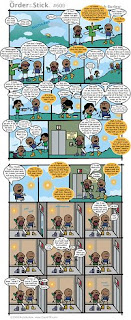
(From The Order of the Stick. Click for full-sized anti-climax.)

Once again, this post has nothing to do with politics, despite my spending two days and a weekend without a word on the subject. I should be returning to it later today.

“I bet everyone was expecting a big battle for strip #600.”

Apparently Grandpa really hasn’t spent much time looking at the world of the living.

There are a lot of things that people were wondering about for strip #600. Perhaps a return peek at Team Evil, with potential huge ramifications, or a look at some other faction we haven’t looked at for a while. Perhaps contact finally being made between the two halves of the Order. Perhaps the prophecied death of Belkar. The previous sequence of strips probably led many to expect either a confrontation or alliance between Vaarsuvius and the imp Qarr. The start of this strip led me to wonder if it was going to end with Roy being called to be resurrected.

But a “big battle”? Not given the state of the OOTS right now, where they’d settle for being in one piece. The closest thing anyone would have predicted to a “big battle” was a confrontation between Haley and the Thieves’ Guild’s Crystal. Maybe, before #599, a confrontation between Vaarsuvius and the rest of that half of the OOTS plus the remnants of the Sapphire Guard.

Since nothing big happened in #600 (unless you count the start of the switch back to Haley, Celia, and Belkar), it’s looking increasingly likely that none of the major objectives of this book will be completed until it’s about over. No resurrection of Roy, no union of the two halves of the Order, no retaking of Azure City, nothing.

Now, given the pace at which Rich Burlew writes, it’s possible that “it’s about over” may be sooner than many of us think. Certainly the union of the Order and resurrection of Roy are things that should probably be taken care of by the end of this book if they are to be taken care of at all. Those are things that need to be set up in turn, and that may take multiple tens of strips. Judging by the last two books, we’d expect this book to end somewhere in the 660s, which means we might expect one of those objectives to be completed possibly as early as the 640s. Or maybe the build will begin about now, considering how much into high gear both plots were starting to move last we checked.

But it’s becoming apparent that this section of the OOTS’ story is going to have far-ranging consequences that could prevent some of those goals from ever being completely fulfilled. This first really became apparent last strip, where Vaarsuvius announced his departure from the ship to find Haley and Roy’s body without distractions, referring specifically to Elan and Durkon. And announcing “I have no intention of returning”. And that he might decide to arrange a meeting between Haley and Elan/Durkon elsewhere… “but probably not”.

It may well turn out that with this action, Vaarsuvius just unilaterally, in an instant, without Roy even being alive to object, kicked Elan and Durkon out of the Order of the Stick. This is especially likely when you consider this strip, in which Vaarsuvius not only fails to grasp who Therkla is but comes to the conclusion that she was Elan’s active girlfriend (despite being present in disguised form when Elan brushed her off). If V can convince Haley of that idea, (s)he might dissuade her from pressing V to chase Elan and Durkon back down.

(Incidentially, early on in my reading of OOTS I had trouble seeing Vaarsuvius as anything but female, partly because of the hair… but as he’s grown more insane and his hair has become more frazzled I’ve found myself using male pronouns more often. Is that worth reading anything into?)

Now comes evidence that Roy hasn’t paid any attention to the travails of Haley, Celia, or Belkar since this strip – he’s still talking about that group having reached Cliffport by now. Which sort of makes me wonder if he’ll even be able to find them. Unlikely, but he will have no idea what’s been going on. (And neither will we. No way “weeks” passed between #572 and the end of our last look-in on Haley/Celia/Belkar.) In a more important development, Roy probably will even be confused by something in evidence towards the end of the last check of Haley and Co.: the curse of the Mark of Justice potentially starting to wane from Belkar.

And there are other far-ranging consequences that have been built for a while that seem inevitable. Vaarsuvius’ insanity won’t be fixed just by finding Haley, or even by finding Haley and a good, long trance, because the last strip seems to suggest V has given up trances for good. Belkar’s been afflicted by the curse of his Mark of Justice and “will draw his last breath – ever – before the end of the year. (That’s an “in-comic” year, not a real-time year, Oracle fans!)” Unless Roy keeps all his memories of what happened while he was dead, including his memories of his conversation with the Oracle, it’s likely that, at the least, something important will happen before he’s resurrected.

It is even entirely possible that no one’s predictions on the future or ending of the comic are correct, because they all assume that the composition of the Order at the end of the strip will consist of some combination of Roy, Haley, Durkon, Vaarsuvius, Elan, and Belkar, and almost always all of the above. The revelation that Belkar’s death would come “before the end of this [in-comic] year” first put a wrench in those plans, but one could easily deal with that. But now that it’s possible that, for the moment, Elan and Durkon are no longer members of the Order, we could be looking at a semi-full-fledged Order of the Stick at the end of this book that shares only Roy and Haley with the Order of the first 500 strips or so (with V insane or even a god, Belkar dead, and Celia officially one of the new members), one that spends as much if not more time trying to find and rope back Elan and Durkon than trying to foil Xykon’s plot. And the prospect of a very different Order of the Stick becomes especially chilling when you consider the Oracle’s prediction of a “happy ending – for [Elan], at least”. If Elan is no longer a member of the Order, what does that say about the Order?

And who’s to say this wasn’t an incredibly important strip… in its very lack of importance?

As for the plot… what can I say? It’s a plot.

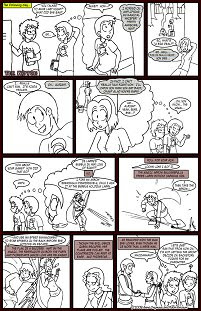
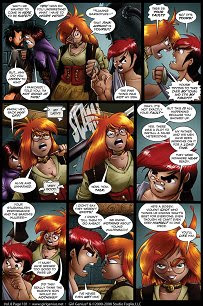
(From Girl Genius. Click for full-sized discussions of idiocy.)

This post, like the last one, has nothing to do with politics or voting, so if you just came in yesterday and you have no interest in this sort of thing, just skip past it. If you’re the sort of person who only ever came to Da Blog for the webcomic reviews, I have an OOTS review down the pipe for next week – which will essentially be a moment in time; I’ll recap my thoughts on the past few strips, probably running through #600 – and that’ll be it until the week after the election.

Phil and Kaja Foglio are miniature Gods of the webcomic community for their decision to switch Girl Genius from a print comic book to a fairly standard full-page webcomic – a decision that implicitly validated the webcomic form as a viable form, and which, to hear Phil tell it, partly came out of a feeling that the Internet was a good business model for comics and partly out of a financial crunch.

But what Phil and Kaja actually did was take the stories they were already writing for the comic book and just release them page-by-page to the web. The result shows, as the strip is rather clearly plotted with the comic book in mind, and there are some strips that make little sense on their own, including at least one splash page. A splash page that leads to another strip that tells us little that we didn’t learn in the previous strip. While following Girl Genius for the past two weeks, I often found myself looking back at the previous strip to see how we got to where we are in this strip. In essence, Phil and Kaja are still writing a comic book, not a comic strip – or rather, are writing a graphic novel rather than a comic strip.

It’s almost like, somewhat appropriately, in Victorian days where writers like Charles Dickens would publish chapters from their coming novels in serial forms in popular magazines – only that really describes the model that has seemed to be the status quo in print comic books, and what Phil and Kaja are doing is to release their novel a paragraph at a time. What I’m trying to say is, the result is rather awkward. When you have different media, you have different expectations and mechanisms for moving the story forward, and the Foglios are using a… different mechanism to say the least. Not that I fault them for doing so – that’s what they set out to do, and especially given the serious nature of the subject matter, they can’t be expected to change to a more episodic form. And they have certainly adjusted their style from the print comics, pages from which have been assigned what appear to me to be arbitrary dates and placed in the archive. Read from the beginning and it’s obvious this was never intended to be released in an episodic form – the story establishes itself too slowly. That’s why most webcomics start with a strip-a-day format and undergo Cerebus Syndrome later.

If there’s any strip that has managed to balance the episodic format of the web with the coherent storytelling of the print format, it’s – guess who! – Order of the Stick. Every strip is a coherent strip in itself, with its own gag wrapping it up, yet also makes sense as a page in a larger book. To pull this off, Rich Burlew will sometimes release multiple pages at once as double or even triple pages, and is flexible enough in the format that he’ll even pull infinite canvas techniques that would be difficult to pull off on the printed page. The Foglios would benefit from double or triple strips on occasion, but that would increase their workload as they’d then have to complete another page faster.

It’s just that I’d be a bit amazed if – as, paradoxically enough, I suspect they do – they had an audience that was much more than just the people along from the print comics, especially ones that hadn’t already taken the massive archive binge, as the pace of the story and the incompleteness of the fragments would likely turn anyone else off from trying to follow it day-by-day.

A webcomic post that isn’t about Darths and Droids or Order of the Stick? It’s the apocalypse!

(From PVP. Click for full-sized awkward re-introductions.)

Here’s what’s happened over the past year in PVP:

First, Jade was invited to a high school reunion, which started out fairly normally, until it turned into a murder mystery (and a locked room mystery to boot!), with the obvious suspect soon ruled out and turned into the murderee. Oh, and there’s a fairly blatant continuity error.

Then Brent and Jade showed up as superheroes for a halloween party, which thankfully lasted for only two strips, before Cole pressed Francis into training the rest of the gang for a Halo 3 battle with Max Powers, prompting Brent to ask, “Since when is this comic strip about video games again?” The match itself takes place entirely off-screen, though, and is also mercifully brief.

Then a panda in the office nearly dies, and with Brent’s interference almost does, attracting the attention of the WWF, touching off a flashback sequence that’s really a three-strip Liberty Meadows tribute, complete with Frank Cho art, ending with Brent bringing in the panda and trying to pass it off as Skull. The WWF reintroduces the panda to the office on the grounds that it can’t survive outside an urban setting, and effectively bribes Cole into keeping him, allowing Cole to buy out Max Powers and end the financial support he’d been providing.

That leads into the annual rising of Kringus, demon god of Christmas trees, which – in a last-minute change in Scott Kurtz’s plans – consists of Kringus and Scratch teaming up to steal presents and steal the secret of world-travel-in-one-night from a mall Santa, only for said Santa to turn all bad ass on Kringus, only for Scratch to taze him and reveal him not to be the genuine article.

I’m only three months into the past year. That’s before Shecky, Skull’s cousin, shows up and takes Skull to impress the woman he wants to be his fiance, only for her to decide that just because Skull loves Shecky, doesn’t mean Shecky has any redeeming qualities. Since it can’t just end like that, Skull and Shecky get into a bit of a bother, which Madeline (who did I mention is a Gorgon, better known as a Medusa?) exonerates Shecky for, though not for the reasons Shecky thinks.

Then things return to some semblance of normalcy as it only now dawns on Brent how much Francis looks up to him, just as he set a date for his wedding with Jade, which he makes up for by making Francis the ring bearer and making it sound like Lord of the Rings. Then Francis decides to keep the name Brent changed one of his World of Warcraft characters to as a joke, and along with Skull, starts forming an in-game guild, in a setup to the launch of a spinoff comic.

Then Scratch starts modeling his world domination plans after Garfield, then considering modeling it after Calvin and Hobbes. Then Cole trash-talks his way right out of being the best man, briefly plopping Francis in the role until it turns out to be a result of trouble in his own marriage. That leads to Cole rooming with Brent for the moment. And then Brent gets surprised by his parents who don’t want to wait any longer to meet Jade, and Brent’s father pressures Cole into making up with his wife, which leads to an office paintball tournament, which Miranda turns out to be an expert at, and which ends when Brent suffers a dislocated nipple. A dislocated nipple. Which means he has to wear a bra. And it turns out they left Skull behind in the woods which turns into another super-serious mystery as he goes on a mushroom-induced high.

Seriously, you will never see a more ridiculous serious line in your life than “Cole, get the equipment out of the van. We’re painting troll tonight.” Not even in a fantasy story.

And the whole thing ends when Kurtz himself shows up and ridicules the ridiculousness of the whole thing.

Then, after a lengthy bout of guest strips, the wedding arc itself starts with – if you saw this coming collect your prize! – Jade backing out. Well, turns out it’s not Jade, it’s her mother by way of Miranda, so Cole has to ask Robbie for a favor. And even the wedding becomes super-serious when Skull’s case worker shows up to tell him his job is done. And Brent is slow enough to let go that he knocks a statue’s head off with a golf club.

Sensing a pattern here? Utter silliness wrapped up in mega-serious plots. Perhaps we call this PVP Syndrome?

Okay, I know that didn’t make sense, so to further clarify what I mean by PVP Syndrome (or maybe it’s Goats Syndrome), let’s compare PVP to Order of the Stick. Both underwent Cerebus Syndrome, but OOTS was always very well-grounded in a fantasy setting. It wove a compelling plot with new elements that made sense in the setting. I haven’t read much PVP at all beyond the past year, but I get the sense that once upon a time, it was just about a bunch of people in a magazine newsroom. Yes, they had a giant blue troll as a friend, but other than that it was essentially a standard workplace comedy. Well, some of those more outre elements have become even more outre, yet they’ve also helped provide the underpinnings of what’s presented as a fairly serious plot, and it just doesn’t mesh.

Eric Burns described Cerebus Syndrome as “the effort to create character development by adding layer upon layer of depth to their characters, taking a character of limited dimension (or meant to be a joke character) and making them fuller and richer.” That’s essentially what, over the years and especially recently, Kurtz has tried to do with Skull: create a broader underpinning for the character and his concept – but not really changing the fact that he’s a big blue cuddly troll who hangs out in a magazine office. He tried to put Skull through Cerebus Syndrome but he failed. That’s PVP Syndrome: trying to put your strip through Cerebus Syndrome, but through a misunderstanding of your own material, botching it so badly and creating something so unintentionally hilarious it comes off as something out of Bizarro Monty Python.

Seriously. Brent knocked the head off a living statue with a golf club. At his own wedding. And at least superficially, it’s supposed to be treated completely seriously.

Something tells me PVP needs to lose Skull at this point – if not to shake up the status quo (how much does the wedding of Brent and Jade change things, really?), to stop from becoming totally insane. Yet he just returned to Brent and the PVP gang (more on that later). It’s been hardly four months since the wedding and the strip is inexorably being drawn back to its old status quo.

And I’m not even going to talk about the Francis-and-Marcy-have-sex thing.

Then we get the misadventures of Skull’s new charge, which ends badly. Then we have more panda misadventures, this time involving a female panda who has to be brought in to copulate with the one they already have, which ends with the revelation that Brent has “the spirit of the panda inside [him]” and dressing up in a panda suit to fight the real panda, which ends when he accidentially knocks the real panda out and gets the girl panda all hot and bothered for him. But at least the boy panda has a new respect for Brent.

I swear to God I am not making any of this up.

Then Skull’s misadventures continue with a Family Circus parody, only to be saved by a Foxtrot parody. Then Robbie tries to work out his personal issues with Brent and Cole, prompting them to try to work things out with his friend Jason, who assures them that everything’s fine, which is belied by their actual interaction. The operation, then, is a success, much to Cole’s dismay.

Then we get an “interlude” where a bunch of literary supervillians team up to take on “the Lolbat”, a Batman parody that speaks mostly in Internet slang and mangled grammar, which ends badly. Then Francis and Cole get into an argument that seems intended to mirror D&D 4th Edition debates. And finally, in the current story arc, Scratch vows to get Skull back come hell or high water, starting by confronting Shecky, who gives him a key to the land of magic, where Scratch goes on a rampage, leading Madeline to agree to return Skull.

I haven’t even talked about the extraneous stuff, like the guest strips and the parody of 60s cop shows.

The funny part is, I actually developed more of an appreciation of PVP after reading all of that, and the growth and development of the characters and their relationships taking place all the while. But the two times I’ve attempted to start reading PVP have been during the second panda storyline above and the most recent storyline, and neither one has left a good taste in my mouth, seemingly proving to me that the general rule of webcomic popularity is that the weirder and more surreal, the better. I’m not even sure I understood the current storyline on first read.

This is a reference I know will resonate with Kurtz: Julius Schwartz was a comic book writer and editor, and one of the things he was fond of saying was that “every comic is someone’s first.” (I know I’ve heard that quote, but all of a sudden I’m not sure it was Schwartz’s, since he also said “the Golden Age of Comics is seven” or something like that.) Now, comics since then have largely forgotten those sage words, but that doesn’t necessarily make them any less relevant. Webcomics also have a propensity to forget them, maybe even more so, a natural result of the fact that any story-based comic is likely to have someone join in in the middle of some story arc, which is one reason why Eric Burns has recommended that any webcomic have some sort of cast page – any cast page, even one that hasn’t been accurate since the very first strip (which is why he’s also disdained webcomics that have taken down out-of-date cast pages).

But all the cast pages in the world can’t save someone’s readership of a strip if the first strip they see makes them decide it’s not their cup of tea. It’s possible for a mid-story strip to be a good introduction to the strip – I first fell in love with OOTS by reading an early strip in the battle of Azure City and becoming fascinated by the whole battle. But the current storyline is only resonant (and arguably only makes sense) if you already know who Skull is (thankfully he is listed on the cast page, which can’t be said for a good many others), that and why he was taken away, and even then you’d probably need to jump in fairly early in the storyline to understand what’s going on. With either of the storylines I started with, you might be left with the impression that PVP is a random, nigh-incomprehensible mess.

That leaves me with the impression that Kurtz is really writing for continuity-hungry fanboy geeks who jumped on board when PVP was good and popular, not trying to reach out to new readers. Perhaps this is to be expected, and perhaps Kurtz has a specific end point in mind with PVP and so doesn’t see the point in bringing in anyone new… but it’s interesting to note that Order of the Stick, a strip with a natural, clear end point, hasn’t gotten so bogged down in continuity as to turn off potential readers. All I know is that PVP gives the impression of pure chaos and randomness run amok, even if it isn’t and even if it’s still fairly decent, and that could magnify its already rather concerning flaws and obscure its virtues.

I’d like to think the ticket to webcomic popularity isn’t to be as weird and random as possible…

(Webcomic reviews will last one or two weeks into October and could resume in November depending on how easily I balance everything I’ve already signed up for until then.)

You know the drill. OOTS fawning ahead. Here there be spoilers.


(From The Order of the Stick. Click for full-sized planning ahead.)

I found a recent comment from Robert Howard that stated that Tangents would take a couple of months to come back in full. Which means I can put up all my other OOTS thoughts while I wait. I’ve added yet another one to the stack, and neither one of the two I was thinking of is the one I want to look at today.

This one concerns the very structure of OOTS that has sprung up recently. At the end of the last book, Rich Burlew split the Order in twain after killing off their fearless leader, and since about #500 the strip has largely consisted of shuttling between the two groups: Vaarsuvius, Elan, and Durkon on the one hand, and Haley, Belkar, and non-member Celia on the other. (Roy’s ghost has popped in once or twice with the latter, though the Oracle of Sunken Valley has been the only living being to see or hear him so far, and we also shuttled over to Team Evil for a spell, and their captive paladin O-Chul.)

Nominally, both branches of the Order have been concerned with reuniting, resurrecting Roy, and continuing their quest to stop Xykon’s evil plot. The former, and thus the latter two as well, has been restricted by a magical spell surrounding Haley and Belkar that only they and Celia know about, coupled with the fact that the only members of the group able to make magical contact with them, or resurrect Roy, are with the other group (while Roy remains with Haley and Belkar).

Haley, Celia, and Belkar have remained largely focused on their goal, although the group dynamics between them have been, in large part, the focus, and the last time we saw them Haley’s past looked to be catching up to her. However, Elan and Durkon, powerless to do anything about the situation, have found themselves distracted by the travails of their hosts, Hinjo and the in-exile government of Azure City, especially the plot against Hinjo by the rogue noble (possibly with otherworldly backing) Kubota. (V has been just the opposite, so focused on trying to find Haley and Belkar it’s caused him/her to do the elvish equivalent of “lose sleep” and grow distant from the rest of the group.)

As a result, the story of this half of the Order has little to do with the overall superplot of the strip at all, and has been, essentially, a self-contained story of its own. It is, essentially, Elan’s story, which is why I was hoping to link the Tangents-derived post to this stage of the story, even though recent strips have cross-cut between the tribulation in the strip above and the battle with a massive demon. Kubota’s top minion, Therkla, has been distracted from her “kill-Hinjo” mission by her growing “feelings” for Elan, which until recently Elan was mostly oblivious to, and Kubota was barely oblivious to. Now that plotline has been building to a climax worthy of a Bond movie, which makes it all the more appropriate that Elan would be at the center of it – and which, especially coupled with the renewed promise the last time we looked at Haley, Celia, and Belkar, pretty strongly suggests the group will reunite at or around #600.

Interestingly, it’s not clear exactly what role Therkla plays in this story. At first glance, she’d appear to be a classic femme fatale, especially since Elan has been an item with Haley since just before the battle over Azure City. However, Elan has never been at risk of turning to the side of evil, or even really being distracted from whatever he needed to do. When Therkla suggested just being together until Haley returned, Elan rejected even that without a second thought (although it’s unclear just how much he’s willing to stick to that position). If anything, it’s been Therkla who seems to have genuinely been drawn, if not exactly to the side of good, at least away from the side of evil, with Elan being the unwitting “femme fatale” in this case – a point driven home when Kubota initially put Therkla in the “him or me” position instead of Elan. In fact, it’s been suggested that Therkla has never even really been evil, but has only been loyal to Kubota for giving her a place where she can fit in. (Therkla’s a half-orc and there’s a long tradition in science fiction and fantasy of half-breeds being rejected by both sides of their lineage.)

This is not the first time Burlew has brought us a story quite this divorced from the overall superplot, which hasn’t really advanced that much since the battle of Azure City. The lengthy bandit episode had little to do with the superplot, as did the starmetal quest that it took up the bulk of. The only real time we had a story quite this divorced from the superplot, at least since the effective start of it, has probably been the last encounter with the Linear Guild, which by and large, Elan also stood at the center of. The foreshadowing of that story, incidentially, started at the very beginning of the starmetal quest and wasn’t resolved until right before #400, a delay of over 250 strips - suggesting it may be a long wait indeed for anything quite so momentous to befall the one thing there’s any real foreshadowing of at the moment, which ironically, would be the next advancement of the superplot. In a sense, it’s stories like these that keep the strip from going “mad”, as it were, with focusing on a single plot it advances above all else, and allows it to keep a little bit of the magic from the Original 42.

Don’t worry, the webcomic reviews should return to Tuesday after this.

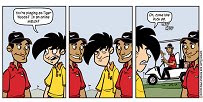
(From Penny Arcade. Click for full-sized infinite Tigers.)

Because of time constraints, low battery power, and the fact my first attempt at this post got lost partly because of my own stupidity, this post will be an experiment in shorter webcomic reviews.

Penny Arcade is, by almost any measure, the most popular primarily-web-based comic in history. Millions of people peruse it every Monday, Wednesday, and Friday, and who knows how many of them have tried their own knockoffs of the PA formula. Jerry Krahulik and Mike Holkins often do promotional work for actual big time game companies and their actual games. “Gabe and Tycho” have created more memes than anyone this side of xkcd (Greater Internet F**kwad Theory, anyone?) and managed to channel their many readers’ efforts into their Child’s Play charity. They’ve even started their own gaming convention, the Penny Arcade Expo, on the backs of their wildly successful comic strip, further establishing their bona fides as among the most powerful people in the video game industry.

And for the life of me I can’t figure out why.

Now I’ve only read a couple weeks’ worth of strips and almost nothing outside of this year, so maybe the strip has jumped the shark and I just missed all the good strips. But Penny Arcade, in a lot of ways, reminds me of xkcd, in that I don’t know what to make of it. Many strips, like with xkcd, feel like little more than moments in time; Gabe and Tycho famously disdain continuity, and in fact are really the only two recurring characters. Often their strips are like editorial cartoons for the game industry, except they tend to be laden with injokes and sometimes are incomprehensible without the accompanying blog post. I don’t know if I’m in a position to appraise the writing, but the art… isn’t bad, and it’s certainly better than most PA knockoffs (then again, so is Ctrl+Alt+Del‘s art), but it isn’t spectacular either. On the rare occasions when the strip does dip into continuity, they can lack flow even with the blog post. (So, exactly what did happen to Tycho between these two strips?) Some strips feel like they’re missing a panel, or crammed into one panel too few, or fall flat for other reasons.

If you go to the Penny Arcade home page, you’re not taken to the comic but to the daily blog post. I can’t help but wonder if this is the real core of Penny Arcade‘s popularity; if most of the site’s readers come in not for the strip, but for Gabe and Tycho’s various musings on the goings-on of the video game industry, including the occasional video game review. Which makes it odd that Gabe and Tycho are so often held up by webcomic boosters as an example of All That’s Right with webcomics, when their strip may well be mediocre at best and probably isn’t the main draw to the site. Their praise may just encourage PA knockoffs who actually do a better job than they’re often given credit for of aping the PA style and quality, but don’t really get it, and don’t really grasp why PA is so popular, even having perfunctory blogs but letting the strip drive the blog rather than the blog drive the strip.

Of course, on the other hand, the geeknerd core audience of many a webcomic tends to like semi-surreal rule-breaking things. I guess it’s up to people like me to point non-geek webcomic shoppers to strips that are actually doing good things with the form like Order of the Stick.

Speaking of gamer comics with a reputation for crappiness, after reading today’s Ctrl+Alt+Del, I may have to push back the Penny Arcade review a week or two.

(From Powerup Comics. Click for full-sized blissful ignorance.)

As much as I’ve criticized YWIB over the past couple of days, I do sympathize with their frustration, and to tell you why I need to tell a little story.

Once upon a time, some people at the Truth and Beauty Bombs forums (the forums for Dinosaur Comics and some others, and the place that gave us the “Garfield without Garfield’s lines” meme, which eventually became “Garfield without Garfield” himself) decided to take a bunch of cut-and-pasted elements, throw them in MS Paint, and create the crappiest gaming comic they could. The result was Powerup Comics, and once it started picking up steam among the members, they started a DrunkDuck account and started storing their comics there.

But here’s the real punchline: Powerup Comics – intended to be a parody and the worst gaming comic ever – attracted people who treated it completely seriously. And liked it.

A comic intended to be the worst gaming comic ever, attracted actual fans.

When the people at YWIB reviewed Powerup Comics as an April Fool’s joke (which actually attracted some defenses of the comic from people not in on the joke), and ended the review by claiming that there was no point in continuing and so they were ending YWIB, I would not have blamed them for quitting for real. Heck, it’s enough to make me wonder if it’s a lost cause.

It’s hard to see what the strip’s fans see in it, unless they’re actually T&BB members furthering the parody. The art definitely falls on the “distraction” side of the line of badness, for lack of a better term; it’s blatantly an MS Paint copy-paste job, more so than others of the type, but instead of looking computer generated like sprite comics and Dinosaur Comics, it just looks like a 12-year-old drew it (or younger). My artistic abilities must be the crappiest in the universe, yet I actually could ape the Powerup Comics style. There’s the same propensity towards violence as Ctrl+Alt+Del, only so much more unnecessary as to seem completely random. Some strips have no punchline whatsoever (which is itself supposed to be the punchline), some have been done a gazillion times before.

I could go on, but I’ve made my point already. I’ll just point out that the YWIB folks may have inadvertantly hit on something without realizing it, and that’s the real reason for CAD‘s popularity, the distinction between Ctrl+Alt+Del and the mounds of crappy gaming comics they’ve reviewed. Say what you will about CAD‘s art, it’s positively Rembrandt compared to Powerup Comics or even Cartridge Comics. I could go on, but I’m on a bit of a clock here. Gotta go!

For some reason I thought I had already posted this when I hadn’t even added the images.

(From The Order of the Stick. Click for full sized Common Sense, or lack thereof.)

Well, it’s been over a month since the last time I talked about Order of the Stick at length (and it feels like much longer), and it’s high time for me to revisit the territory. As I’ve stated, OOTS started out as a jokey, funny gag-a-day strip about a bunch of adventurers trawling through a dungeon. It’s now a multilayered political drama, soap opera, and high fantasy tale. In other words, it’s been turned inside out by Cerebus Syndrome, and been about as successful as you could be in doing so, thanks in part to losing none of the humor and metahumor that characterized its early days, and if anything, increasing it.

OOTS even lightly poked fun at its descent into Cerebus Syndrome in this strip, made at a time when Websnark was still king of the webcomics world and still had many of the tics of its height, including the “submitted without comment” routine. For those of you who weren’t here when Sandsday made a blatant push for linkage from the now-mostly-defunct Websnark, I point you to the third panel of this strip. Sure enough, soon there was a comment-filled non-comment from Eric Burns, which contained this doozy: “It was funnier to me since there really isn’t a Cerebus Syndrome going on here, of course.”

A strip makes a joke about its own descent into Cerebus Syndrome when there isn’t one? How does that even make sense? But the first commenter to Burns’ non-comment comment agrees about the lack of Cerebus Syndrome. A later commenter claims “you can’t really start invoking Cerebus when the comic remains consistently and deeply funny” (I’ll have more on this in a sec, but for now I’ll say this seems to imply OOTS still hasn’t fallen into Cerebus Syndrome even now) and compares it to Goats (considering that strip’s descent into fate-of-the-planet-at-stake randomness, probably not the best example, but I’ll check the strips that were out at the time and get bac to you). Even now, if you ask people on the OOTS board when that strip went into Cerebus Syndrome, they’ll probably cite the sequence revealing the Snarl’s existence (a few may alternately cite the introduction of Miko), and the OOTS being tasked to stop Xykon from freeing it, even though if anything that sequence comes at the end of a long transition to a more plot-based model for the strip.

Let’s take another look at the definition of Cerebus Syndrome:

The effort to create character development by adding layer upon layer of depth to their characters, taking a character of limited dimension (or meant to be a joke character) and making them fuller and richer. The idea is to take what was fun on one level and showing the reality beneath it. ‘Cerebus Syndrome’ refers to Dave Sim’s epic, sometimes tragically flawed magnum opus, Cerebus the Aardvark. Cerebus started life as a parody of Conan the Barbarian starring an Earth-Pig born. Over time, it grew extremely complex, philosophical, and in many ways much much funnier. Then, Dave Sim went batshit crazy and Cerebus went straight to Hell, but that’s for another day. People saw how Cerebus’s humble roots could lead to glorious heights, and as cartoonists get bored with what they’re doing, they decided to pull a Cerebus of their own. [...]

It is extremely hard to take a light, joke a day strip and push it through a successful Cerebus Syndrome. Dave Sim did it in stages, and at least in the early days of the transformation brought massive amounts of Funny to cover it over. Done perfectly, one only realizes in hindsight that the strip has turned out to be quite different than it used to be. Done sloppily, the Cerebus Syndrome fails, and the webcomic enters First and Ten Syndrome. Unfortunately, a failed Cerebus Syndrome is an excruciating process for the webcomic’s fans to endure. Please note that one can continue to bring the Funny while going for Cerebus Syndrome — and in fact, probably should. It is far more common to drop the Funny, which increases geometrically the chance to fall into First and Ten.

In the second paragraph quoted above, you could easily substitute out “Dave Sim” for “Rich Burlew”, because that’s exactly what Burlew did with Order of the Stick. There’s a long list of milestones in the march to Cerebus Syndrome taken by OOTS dating at least back to the revelation of the underlying plot in #13, and arguably continuing well after this sequence. Similarly, I suspect part of the reason most people cite the last of these major milestones as the tipping point is that that is the point where these people realized just how far the strip had come from its origins (especially if they weren’t there for those origins and didn’t realize how different they were).

It’s true that the revelation of the Snarl’s existence gave the strip an overarching plot driving all the action and ended about 75 strips of what amounted to aimless wandering, but it’s important to remember that the definition of Cerebus Syndrome says nothing about myth arcs or anything of the sort. It refers only to greater character development or, more colloquially, a general increase in drama and an arc-based model. The former starts appearing at least as early as the opening sequence of the second book, the middle at least as early as Miko’s introduction, and the latter far earlier than either. (And it’s important to remember that Burns specifically notes that a strip need not abandon humor to undergo Cerebus Syndrome.)

Besides, the quest to keep the Snarl imprisoned only really replaced the “hunt down Xykon and kill him” plot of the first book, and by the time it happened it didn’t really mark that seismic a shift. At least as early as Miko’s introduction the specter of Shojo and Azure City was already forming some sort of plot that was promising to carry the OOTS for quite some distance. The first hints of that were laid down at the end of the first book – where, remember, the strip had overturned its entire premise. And by the time the OOTS was brought before the court, Haley was speaking gibberish, the sort of thing that isn’t just a sign of Cerebus Syndrome but a hallmark of the nonstop angst that heralds full-blown First and Ten. And then there’s the little niggling matter of strip #242, where Haley remarks “we were a lot safer when we just made fairly obvious jokes about the rules!” By that point, The Order of the Stick hadn’t “just made fairly obvious jokes about the rules” for some time. A long time.

You want to point out the most important tipping point in Order of the Stick‘s march towards Cerebus Syndrome? The one strip that could best be used to separate the early, happy-go-lucky, almost continuity-free days of the early strips from the more plot-based OOTS we know and love today? The one point that you can point to and say, “This is where The Order of the Stick as we know it truly begins”?

You have to go all the way back to the first book, way before there was even any hint of the Snarl or even of any “gate”. You have to go all the way back to strip number 43.

And I’m not just saying that because I’ve had a fascination with the number 42 since even before I learned of its importance in The Hitchhiker’s Guide to the Galaxy.

It doesn’t look like much, especially if you’re someone used to the sort of strips that characterized the first 42 of OOTS’ existence. But trust me, Elan doesn’t just open the door to the Linear Guild at the end of this strip; he opens the door to plot, to story arcs, to gates and paladins and pseudo-Asian cultures. And Vaarsuvius’ monologue in the middle of the strip proves to be far more prescient, and far broader in scope, than most fans could have ever envisioned.

How pivotal is this strip? By the time all the loose ends are tied up from the ensuing story arc – by the time Durkon, left behind in the inevitable battle with the Linear Guild, finally returns to the group – it is strip number 85. Which means, when dated back to strip number 43, the entire sequence has gone 43 strips. Or just over half of all the strips published to this point. The Linear Guild sequence has lasted longer than the strip’s entire existence prior to it.

There’s a lot in the Linear Guild arc that hints at the strip to come in ways the Original 42 does not, starting with the slower pace of the plot compared to the limited arcs done in the Original 42. Not to mention the existence of some sort of long-form plot. We get some of the early hints of deep characterization (the OOTS were basically two-dimensional characters before the Linear Guild arc gave us such things as Elan’s backstory) and relationships between characters (at least nominally, virtually all of Nale’s actions after the arc concludes derive from a single panel in this strip). We see long-term planning starting to bear fruit, including the realization of a prophecy dating to #15 (which Haley even points out!).

We get the start of multiple ongoing running gags. We get the introduction of not only the group of villains secondary only to Xykon and his minions (at least through the end of the third book), but also Celia, who subsequently reappears to defend the OOTS in front of Shojo in the sequence that introduces us to the Snarl, becomes at least a brief fling for Roy, and is currently adventuring with Haley’s half of the OOTS. Although the art continues to evolve until at least Miko’s introduction, it’s during the Linear Guild arc that the dialogue reaches its current font size. And it’s before those last loose ends are tied up that we learn the deeper motivation for Roy’s hunt for Xykon.

The very next arc involves bypassing the entire rest of the dungeon and cutting straight to Xykon’s lair. That’s V’s plan from the start and, although that attempt doesn’t end well, that’s essentially what ultimately happens. If I was wrong in my initial post – if Rich’s descent into Cerebus Syndrome, as Eric Burns describes in part of his description I didn’t quote, was a result of boredom, not planned from the start (and remember, I own none of the OOTS books with accompanying commentary) – it came either after the original 42, or during or immediately after the Linear Guild episode, through the “bathroom break” of #86-87. The sheer number of subsequent subplots set up in the Linear Guild storyline suggests to me that, if Burlew didn’t decide from the start what he was going to do with his strip, he sure did before completing 43 strips. (And he probably had some idea before completing 15, judging by the long-term nature of Eugene Greenhilt’s prophecy. Even Elan’s recovery of a Belt of Gender-Changing in strip 9 winds up having importance over 200 strips down the road.)

From Rich Burlew’s perspective, I would think that strip 43 is where the transition – in retrospect, shorter and quicker than I let on earlier – from the gag-a-day OOTS of the Original 42 to the arc-based, plot-based strip we know and love really occurs. And from the perspective of someone who was around for those Original 42 strips (which again, I am not) it would have seemed impossible before #43 that in just 80 more strips, the Dungeon of Dorukan would be blown to smithereens and Xykon presumed dead (well, deader than before). And that such an event would not herald the end of the strip.

Even at the time, it would take until the revelation that Xykon still stands to really convince anyone that the end of the strip was not imminent, and until Miko shows up there’s not really much in-story reason for the OOTS to stick together at all. Take a look at this strip, fairly deep into the second book (deep enough that not only is it a wonder the OOTS stuck together long enough to reach the town (remember, I’m not a D&D player), it’s a wonder they’re still together even after reaching there) – Roy’s hunt for the starmetal is the only reason why the Order sticks together after destroying the Dungeon, and Roy’s swift-talking of Belkar and Haley is the only reason they stay in the group. Had it not been for that, the Order may well have never been tasked to stop Xykon from freeing the Snarl.

(Hmm. And Roy’s hunting of the starmetal was caused by Sabine shifted into a blacksmith. The Linear Guild are responsible for keeping the Order of the Stick together! I smell a fourth post brewing…)

Even in the Order’s subsequent relatively aimless wandering, no one would mistake it for being a gag-a-day strip, and in fact there are next to no “fairly obvious jokes about the rules” at all. The strip is fairly tightly organized into arcs, with a good part of the strip between the Order’s departure and Miko’s arrival taken up by the Order’s encounter with a group of bandits. There are also two semi-lengthy interludes involving Team Evil that help to establish their plot, one before the bandit arc and one, as previously mentioned, between the recovery of the starmetal and Miko’s arrival.

I mentioned some of the points in this post the last time I wrote a lengthy post on Order of the Stick. I mentioned how OOTS managed to overthrow its entire premise by the time the first book was over, and how it managed to keep going thanks to a strong balance of a compelling story and funny jokes. This, then, is something of an expansion of that post, showing just how early Order of the Stick started its metamorphosis into the rich, multilayered strip it is today, and both how much more sudden and more gradual that transformation was. And it ends, as I tend to, with a whimper because I always have trouble wrapping these posts up.

So I’ll see you in another month with an analysis of another aspect of OOTS.

No, this is NOT because I’m just jealous or I want to put down Dinosaur Comics in favor of my own comic. At least, I don’t think so.

as panel one and five indicate, i did a bad job of blocking and spacing the text(From… well… not from Dinosaur Comics. Click for… well, it’s kind of already full-sized, isn’t it? Or it would be, if Blogger allowed me to upload it at actual size…)